dataviz-portfolio
| Home Page | Visualizing Government Debt | Critique by Design | Final Project I | Final Project II | Final Project III |
Wireframes & Storyboard
Initial Chapter 1: The Set Up
In this section I will talk about the growing popularity of books being adapted to movies, a brief process of adapting a literary work into a movie and some of the most notable adaptations and discuss trends in the space. I will then drill down my focus on specific literary works (I currently plan on using The Hunger Games, Harry Potter, Twilight and The Lord of the Rings).
Updated Chapter 1: I updated this section by breaking it into two parts - an introduction prior to this section to provide a summarized excerpt of what this story is and then the contents planned above. A change I made, given the limited consistent data I had available was using various different examples of adapted content instead of choosing specific ones.
Initial Chapter 2: The Impact on the Film Industry In this section I will focus on discussing the benefits of adapting books to movies, highlighting the differences between standalone adaptations and series adaptations
- Box Office Impact: I will provide data-driven insights into the box office performance of adaptations vs original films in a specified year, using graphs and comparative statistics including budget vs. earnings comparisons
- Global Success: I will also include the reach of such films, including data on global box office metrics and market reception.
Updated Chapter 2: In this section, again due to the limited data, I chose to use box office performance of a range of years to highlight how adapted content is prevalent and consistently ranks in the top 3 highest ranking movies in the box office. I also highlighted the global reach of these movies further helps the film’s revenue adn reach, as planned. I plan on adding the budget element in part 3.
Initial Chapter 3: The Impact on the Publishing Industry Although there is limited publicly available data, this section will focus on the indirect effects of the adapted films on publishers
- Sales Surge: I will include specific examples, where available, of the effect of movie adaptations on book sales, with before-and-after analysis, highlighting any long-term impacts on the author’s subsequent works.
- Marketing Strategies: I will also also include relevant details on how publishers capitalize on the film release with special editions, marketing strategies, and cross-promotional activities which generate additional revenues. I will also supplement this with data from Google Trends, to talk about how there is an uptick in searches for the IP as well.
Updated Chapter 3: For this section I included as much data I could find on book sales, and made a visualization in canva to support to try and enhance the aesthetic element of my story - however, I do think I could refine it further to make it more accurate and appropriate. I also included data on series vs standalone book sales and Google Trends data, which was extremely limited. I will add a few more and try to recreate these graphs as well.
Initial Chapter 4: Potential Issues Here I will highlight specific challenges encountered in the adaptation process, such as cost constraints, the uncertainty of knowing whether a film will be successful, the increase in audience responses and engagement, and factors that can lead to successful adaptations.
Updated Chapter 4: I kept this section simple, as per plan.
Initial Chapter 5: Future Directions** (Call to Action) In my final section, I will encourage stakeholders in both industries to consider the benefits of staying true to the source material and proposing guidelines or criteria to ensure respectful and successful adaptations. I will also add material for future works that are in the process of being adapted, or books that have had their rights bought by known production companies. I will also include links to Goodreads and Letterboxd, where people can review books and movies as well as any material that is relevant to the discussion of adapted works such as books, panels, interviews, support for appropriate pay for authors etc.
Updated Chapter 5: I’m not the most satisfied with this section, I still thinking it needs some more work to make it effective. I stuck to the plan from part 1, but I am hoping my user research will help give me some more direction.
I am still working on my visualizations to ascertain exactly what data would make my story the most compelling, as well as ensuring that the examples I use to support my story are universally known.
User Research
As I begin to start seeking user feedback, I hope to start gain better insight into whether my intended story is being reflected, and what I can do to update and enhance the user experience. Since data for this particular topic is a little hard to find, I will beging my narrowing my scope and identifying exactly which franchises and standalones I am trying to show, and ensuring that focus is supporting the story I am trying to tell. I also want to test whether the story resonates with my intended audiences.
Target Audience:
- General Public: Casual book readers and movie watchers who consume content that is interesting to them, not specifically inclined to one or the other, however, those who have industry knowledge and frequently engage with discourse related to their preferred content.
- Literary Fiction Fans: Individuals who consume both literary content as well as watch films and TV and fall at the intersection of the two. For these individuals, my primary focus is identifying whether they enjoy seeing their favorite fiction come to life, what they like about it, points of concerns and what industry leaders can do differently to ensure their needs are met.
- Industry Professionals: Stakeholders who are interested in knowing where to put their money when it comes to creating, acquiring and developing new content that resonates with a wide range of audiences. In addition to this, stakeholders who are in the publishing industry who are seeking film and TV professionals to help them adapt and bring their content to live-action.
Keeping these audiences in mind, I want to interview users who fall into each category and ensure that the information I am providing resonates and provides value to each group.
Interview 1: Female, early 20s, graduate student, casual reader and avid movie watcher Interview 2: Female, mid 20s, Digital Production Executive, avid book reader and movie watcher Interview 3: Male, mid 30s, Media and Entertainment Consulting Professional, knowledge of current affairs in the entertainment landscape
Interview Script
| Goal | Questions to Ask |
|---|---|
| Understand if the story is easy to follow | What is your initial response to the structure of the story and what do you think it is trying to tell you? |
| Identify what elements resonate the most with the audience | Was there anything you found surprising or interesting? |
| Determine what could be done differently to tell a more impactful story | What could be done differently to make the story more compelling (specifically any other elements or data points to add/remove)? |
| Find out whether the call to action logically flows into the story | Did the call to action tie into the story? |
Interview Findings
| Questions | Interview 1 | Interview 2 | Interview 3 |
|---|---|---|---|
| What is your initial response to the structure of the story and what do you think it is trying to tell you? | The story is easy to follow - I think it’s telling me about how book to movie adaptations can be successful if done right | I really liked the breakdown of the story by chapters. I think the intention is to highlight the popularity of literary adaptations. | I think the overall structue made sense - it was clear that you’re trying to show how adaptations are made, how they benefit the stakeholders and strategies to maximize gains |
| Was there anything you found surprising or interesting? | It’s always interesting to see the surge in popularity of series, especially fantasy. I think your data made it easy to really see this | I didn’t realize how little money authors get from this. It’s an unfair deal, especially for those who write multiple series and books - but maybe it’s helping their overall popularity? | I didn’t realize how many books were made into movies and TV shows. I’m noticing the trend is more aligned toward YA content |
| What could be done differently to make the story more compelling (specifically any other elements or data points to add/remove)? | You could talk about Dune’s success, since it’s more recent. The rest of the films mentioned are universal enough. I like the addition of the Google Trends data | The data is helpful and makes a compelling case. You could add more data on other genres of films potentially, if you want to pivot and include that as well | I think the photos and - some graphs could be made bigger to better see the data more clearly. You could also add more data for book sales, but I’m not sure how easy that would be gto find |
| Did the call to action tie into the story? | I think it makes sense! I can’t think of anything else that’s more “direct” | I think there’s a lot going on with your call to action, but it makes sense given the elements of your story | Yes, but you could always add something that is more literal to make the end persuasive and actionable for each of your stakeholders |
Overall, the feedback I received from my user research was positive and constructive. It helped me the most in the call to action section, because I realized I could restructure the section to make it the actions specific to the intended target audience. This could help me further align to my audience as well as make the action item more tangible and specific. I do think there are a few formatting elements for me to clean up, making sure everything is legible and clear. I think everyone liked the format I chose, to try and make each section a “chapter”. I think this made the story engaging and on theme.
I would love to have had more data on book sales pre and post the movies. I tried finding this through different data resources to no avail. The same goes for Google Trends data. Both these data elements are quite limited in terms of the years found online and through reliable sources, so I had to work with what I could to make my visualizations. I’ve tried my best to include as much as possible, but I definitely think having more would make my story more compelling, as determined by my user research as well. This did however make me think that perhaps I could add more data to story in some other regard to try and make the whole story more compelling. I will look into how possible that is in the next part.
I also got some additional feedback from the in-class critique, and although it was a different audience than intended, it helped me understand that I could definitely work on ensuring I have adequate data to support my claims. They all felt the intention of the story came through successfully, liked the general theme of my draft and felt the visualizations I did have aligned well with the story I was telling.
I will use these things to determine the changes I need to make going forward.
Identified Changes for Part III
Going forward, I plan on incorporating the elements of the feedback received: adding more data, exploring more Google Trends data, identifying some standalone series to highlight, breaking up the call to action into meaningful sections based on my target audience and lastly, figuring out a way to embed my tableau data visualizations in the appropriate sizing to make them visible. I also want to still add another dataviz with regard to production budgets and adapted content to illustrate how the benefits in terms of revenue outweigh the costs.
I think these changes will put me in a better place in telling a compelling and strcutured story.
Moodboard
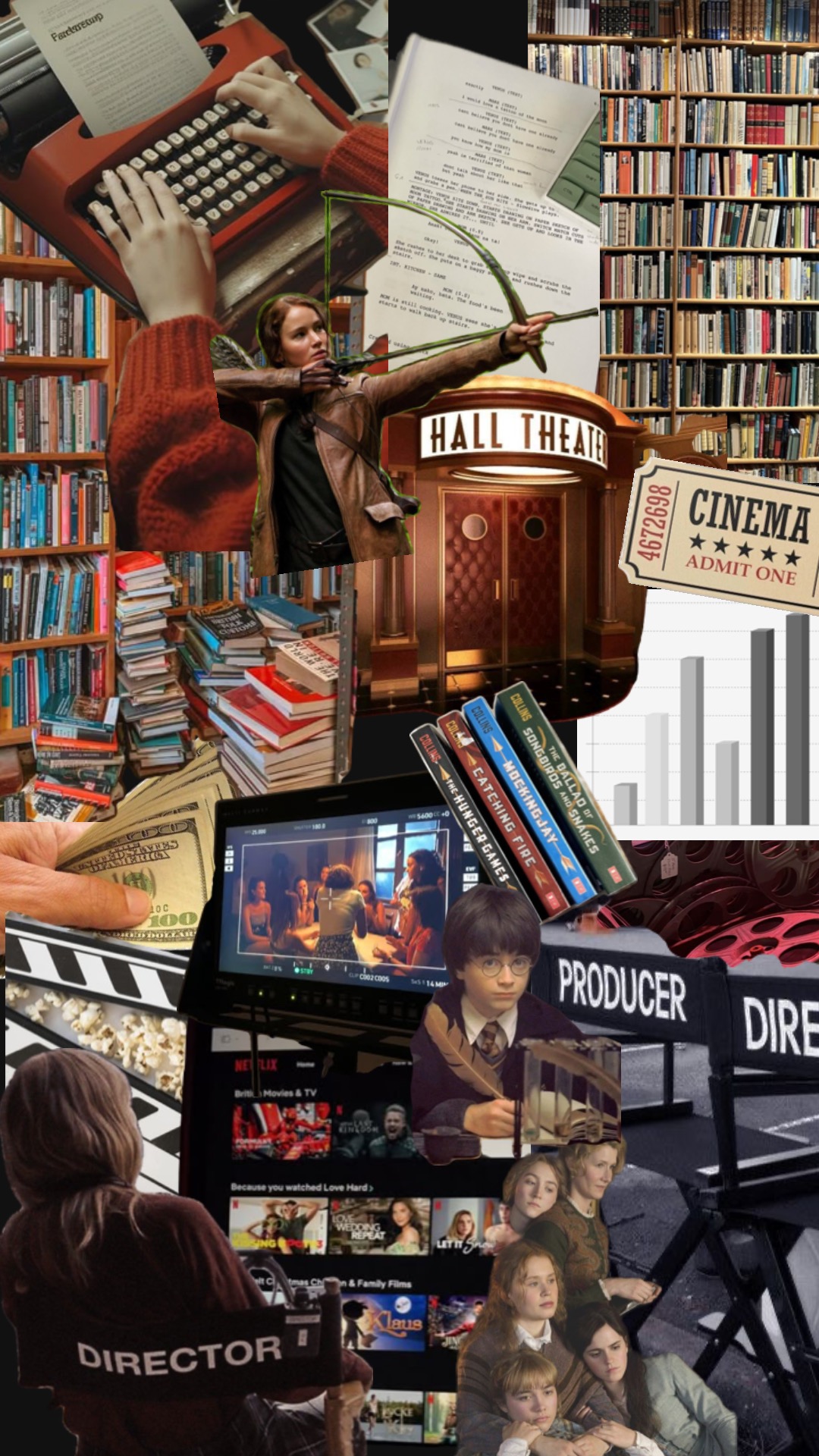
I wanted to create a general moodboard for the colors, main ideas and characters/books I was going to focus on!